
Padikkal's 199 is the story; his 32 inside 113 is the evidence
**मुख्य उत्तर:** भारत A और न्यूज़ीलैंड A के बीच लिंकन में खेला गया पहला अनऑफ़िशियल टेस्ट ड्रॉ रहा, क्योंकि चौथे दिन न्यूज़ीलैंड A 187/9 पर था और बदनूर के कारण खेल नहीं लौटा। देवदत्त पडिक्कल ने दूसरी पारी में 248 गेंदों पर 199 रन बनाए, जबकि उसी मैच की पहली पारी में भारत A सिर्फ़ 113 पर ढेर हुआ था। **मुख्य तथ्य:** - भारत A: पहली पारी 113 (साइमन कीन 5 विकेट, ज़ैक गिब्सन 3), दूसरी पारी 516 — एक ही मैच में 403 रन का अंतर। - पडिक्कल का 199 स्ट्राइक रेट 80.2 पर; 199 में से 114 रन (57.3%) चौकों-छक्कों से आए। - न्यूज़ीलैंड A ने 313 के लक्ष्य पर 65 ओवर में 187/9 बनाए — 2.88 रन प्रति ओवर। - कर्टिस हीफी 187 गेंदों पर 90 रन नाबाद रहे, जो टीम के चौथी पारी के रनों का लगभग 48% है। - आकिब नबी ने दो पारियों में 6 विकेट (3+3) और 38 रन बनाए — मैच का सबसे मज़बूत चयन-संकेत। **स्रोत:** स्टेज-1 मैच रिपोर्ट, भारत A बनाम न्यूज़ीलैंड A, पहला अनऑफ़िशियल टेस्ट, लिंकन। प्रकाशन तिथि स्रोत सामग्री में उपलब्ध नहीं। पिच रिपोर्ट, टॉस का नतीजा, दूसरी पारी की गेंदबाज़ी के आंकड़े, प्रति गेंदबाज़ ओवर और DRS उपलब्धता स्रोत में दर्ज नहीं हैं। **संबंधित प्रश्न-उत्तर:** प्रश्न: पडिक्कल का 199 टेस्ट क्रिकेट के लिए तैयारी साबित करता है? उत्तर: नहीं — यह ऊँची छत का सबूत है, नीची ज़मीन का नहीं; उसी मैच में 113 के कुल स्कोर में उनका 32 ज़्यादा निदानकारी आंकड़ा है। प्रश्न: मैच ड्रॉ क्यों हुआ? उत्तर: चौथे दिन बदनूर के कारण खेल रुका और हालात नहीं सुधरे, जबकि न्यूज़ीलैंड A 187/9 पर था और भारत A को एक विकेट चाहिए था। प्रश्न: भारत A के गेंदबाज़ी आक्रमण की असली कमज़ोरी क्या दिखी? उत्तर: 313 रन की बढ़त और 65 ओवर के बावजूद नंबर 11 को आउट न कर पाना, जो आक्रमण में एक असली स्ट्राइक गेंदबाज़ की कमी की ओर इशारा करता है।
Two in the morning, and the only thing open on my screen was a scorecard from Lincoln: four days, two innings, one batting order. First innings 113 all out. Second innings 516. Between them, roughly twenty-four hours and a shifting surface. The same card carried two lines for Devdutt Padikkal — 32, then 199.
I found that at 2 a.m., somewhere between a buffering video and a hunch. But the hunch had nothing to work with here. A 403-run swing by the same line-up in the same match sits well outside normal variance. That kind of gap comes from one of two places: the pitch changed, or the technique broke in the first innings. The available match report gives me no way to choose between them — no pitch report, no toss result.
What is on the record is more interesting than either. 187 for 9, sixty-five overs, a target of 313, one wicket required, and then bad light. Match drawn. But I am not here for the result. I am here for the one number in this match that tells you the most, and it is not the 199.
What actually happened at Lincoln
This was the first of two 'unofficial Tests' between India A and New Zealand A — first-class status, a four-day structure, but no WTC points, no ICC ranking movement, no Test caps. The purpose is unambiguous: this fixture existed to generate selection information, not competition points.
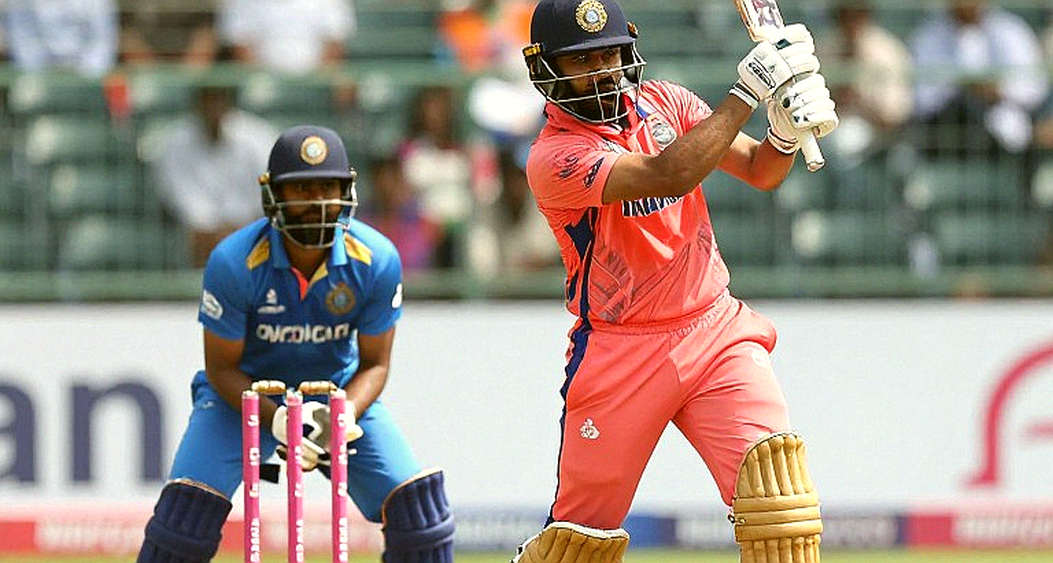
India A were bowled out for 113. Simon Keene took five, Zak Gibson three — eight of the ten wickets to two seamers. New Zealand A made 317 and led by 204. India A replied with 516, built on Padikkal's 199 off 248 balls and a 215-run stand with Sai Sudharsan. New Zealand A were set 313, reached 187 for 9 in sixty-five overs with Curtis Heaphy unbeaten on 90 off 187 and Lennox, the No. 11, at the other end — and then the light went. It never came back. Draw.
Buried in all that: Auqib Nabi took six wickets across the two innings (3+3) and made 38 runs. Washington Sundar made 52 and took one fourth-innings wicket.
The architecture of the 199
A strike rate of 80.2 in a first-class innings is high. A top-order rate of 50-60 is the norm in this format; aggressive Test batting runs 60-70.
This was a tempo innings, not a grind. Twenty-four fours and three sixes — 114 runs, or 57.3 per cent of the innings, from 27 scoring shots. The other 85 runs came off 221 balls, about 0.38 per ball. His scoring engine runs on the boundary, not on rotation. A boundary roughly every ninth delivery is a method that produces 199 and produces 32 in a total of 113 with equal logic.
That is the reading of the 32, and it should not be separated from the 199. Both are outputs of one technique: high ceiling, low floor. The 199 tells you what he can become; the 32 tells you what he currently is when the ball is moving.
What the report does not give — home/away splits, pace/spin splits, a twelve-month trend — is exactly what would turn this from a single innings into a career signal. And the manner of dismissal, given out caught behind one short of a double hundred, matters more than it should at a level where DRS availability is not universal and, in this case, is not even stated.
The left-left stand is the real technical evidence
Two left-handers, 215 runs together. That is not just a statistic; it is a bowling problem. A long left-left partnership forces the seamers off their natural angle and commits a footmark pattern outside the left-hander's off stump, which is the most useful thing a spinner can be handed. How New Zealand A responded — over versus around the wicket, spin angles — is not reported, which means the most interesting technical question has the thinnest evidence. If this pairing reaches senior level, it is a repeatable tactical asset rather than a one-off.
Two wickets do not make an all-rounder
Padikkal's two fourth-innings wickets, one of them his maiden first-class scalp, have been read as evidence of a genuine part-time option. Look at who: Sheat at No. 8, Gibson at No. 9, with seven or eight wickets already down. That is tail-cleaning within a part-timer's brief. The commonest error in A-team cricket is mistaking tail-end wickets for capability. The question selectors need answered is whether he can bowl eight overs on a flat surface against a top order. This match does not answer it.
Nabi's match, Sundar's open question
The strongest selection signal in the match belongs to Auqib Nabi: six wickets across two innings plus 38 runs, out-bowling better-known names. That is precisely the output an A tour is designed to produce.
Washington Sundar is the softer negative. 52 with the bat, one wicket on a surface that had already yielded 317 and 516. If he bowled a heavy share of those sixty-five overs, that is underperformance in the exact role he is picked for. But overs bowled per bowler are not reported, so the read stays directional.
Heaphy's 90* is the innings nobody headlined
187 balls, 90 not out, a strike rate near 48, roughly 48 per cent of his team's fourth-innings runs, with a No. 11 for company. That is a full day with one intention and no risk. It is the most consequential innings of the match and it received no headline weight, because coverage follows the big score. *Scouting runs the other way: the 199 shows how high a talent can go; the 90 shows what kind of temperament a system is manufacturing.** For a small domestic market like New Zealand, that is the efficiency that keeps them competitive.
The close-out India A could not manage
A 313-run cushion, sixty-five overs, five bowlers, nine wickets. Not ten. Calling that bad luck is the easy route and the wrong one. Failing to dismiss a No. 11 with the field up and a big lead is an attack-composition question, not a fortune question. Nine wickets in sixty-five overs looks respectable until you notice the requirement was one strike bowler, not a rotation of accurate ones. It is the same structural question that has followed India's second-line pace attacks overseas, and this time it hid behind the weather.
One more thing, small to read and large in effect: New Zealand A abandoned the chase very early. 187 in sixty-five overs is 2.88 an over against a target of 313. The fourth innings was a survival exercise, which means India A had to take ten wickets rather than defend a total. Those are very different jobs.
The light is the story; the 113 is the problem
The easy narrative is that India A were one wicket away and the weather stole it. That is true and it is incomplete.
Bad light took the result; it did not take the problem. The problem is 113. A 403-run gap between two innings by one line-up is not variance. Either the surface changed sharply or the technique failed in overseas seam conditions — and without a pitch report both explanations stay open, which is why I will not close the case.
But if selectors can lift one number from this match, it should be 113, not 516. The 516 came on a surface that helped. The 113 came in the conditions that become real Tests in New Zealand and England. A high ceiling excites; a low floor decides selection.
The second counter-intuitive point is that 'in vain' is factually loose. That innings turned a 204-run deficit into a 313-run target and gave India A a winning position. It failed to produce a result, not to produce value, and the result was stopped by light rather than by batting.
The third is about availability rather than data: New Zealand A's second-innings bowling figures are absent from the report. A side that takes ten wickets for 113 and then concedes 516 is almost certainly a three- or four-bowler attack running out of resources. Reading 516 purely as 'the pitch eased' discards that half of the story.
The fourth never appears in a scorecard: this was a four-day match. The report says bad light ended play on Day 4 and conditions never improved. A five-day fixture simply resumes in the morning. A four-day format structurally raises draw probability in exactly this scenario, and since no attempt to finish under lights is mentioned, the venue most likely had no usable floodlights. If so, this draw was a scheduling and venue decision as much as a weather event.
The fifth I will flag as uncertain: sixty-five overs on a day with a substantial spin component is at the low end of modern norms, and while no over-rate warning is reported, it cannot be excluded.
What to watch next Saturday
The second unofficial Test begins four days later, with an attack that has bowled a full first innings plus sixty-five overs. Rotation is near certain, which limits comparability but supplies a cleaner data set on the fringe bowlers. Three things, all in the parts of the scorecard people skip.
First, Padikkal's first innings. If the ball is moving and he makes 40 or 50, the 199 gains weight. If the 32 pattern repeats, the profile is confirmed as high-ceiling, high-variance — not a verdict on talent, but a verdict on readiness.
Second, India A's ability to break a last-wicket stand. If it happens again with a big lead, it is composition, not luck, and it needs naming.
Third, Auqib Nabi. Six wickets and 38 runs is an opening; the next match decides whether it is a trend or a good week. The entire economy of A-tour cricket rests on that question.
Lincoln produced no result, but it did produce a sorting rule: the 199 is the headline, the 113 is the evidence. If India A are bowled out under 150 in the first innings again next Saturday, will we still call that match one the weather took away?