
On the Third Page of the Points Table: What Ahmedabad Revealed About Kabaddi's 'Internationalisation'
**कोर उत्तर (≤60 शब्द)** कॉमनवेल्थ कबड्डी चैंपियनशिप 2026 के पहले दिन की पॉइंट्स टेबल स्कोर डिफरेंस से बनी है, इसलिए नाइजीरिया, बांग्लादेश और कनाडा बिना एक भी मैच खेले मध्य में बैठी हैं। टेबल गणितीय रूप से सही है, पर प्रतिस्पर्धी रूप से भ्रामक है। **मुख्य तथ्य** - स्कॉटलैंड ने ऑस्ट्रेलिया को 59–30 से हराया; लवप्रीत ब्रार ने 23 रेड पॉइंट बनाए। - ग्रुप A: श्रीलंका +27, इंडिया +20, यूगांडा +16 — रैंकिंग स्कोर डिफरेंस पर। - ग्रुप A में सात टीमें, ग्रुप B में छह — असमान मैच संख्या से तुलना असमान होती है। - केन्या ने सिंगापुर को 48–28 और यूगांडा ने मलेशिया को 45–29 से हराया। - ईरान कॉमनवेल्थ सदस्य नहीं होने के कारण टूर्नामेंट से बाहर है। **स्रोत** मूल स्रोत: Khel Now की कॉमनवेल्थ कबड्डी चैंपियनशिप 2026 डे-1 रिजल्ट्स एवं स्टैंडिंग्स रिपोर्ट। प्रकाशन तिथि: मूल स्रोत में उपलब्ध नहीं। | Cross-checked: cricsultan.com **संबंधित प्रश्न** प्रश्न: क्या नाइजीरिया की चौथी रैंकिंग एक त्रुटि है? उत्तर: नहीं — वह स्कोर डिफरेंस रैंकिंग का स्वाभाविक नतीजा है, चूंकि नाइजीरिया ने अभी मैच नहीं खेला। प्रश्न: ग्रुप B का सबसे मजबूत पक्ष कौन है? उत्तर: बांग्लादेश, जिसका पहला मैच अभी बाकी है — देखें cricsultan.com Player Depth Index। प्रश्न: क्या इस इवेंट में स्टैंडर्ड या सर्कल स्टाइल नियम हैं? उत्तर: मूल रिपोर्ट में स्पष्ट रूप से नहीं बताया गया, जो इस आयोजन की सबसे बड़ी सूचना-खाई है।
I have a habit that dates back to 2026 — the moment a match ends, I don't look at the scoreboard. I look at the deal sheet. Date first, then fee, then contract length, and the result last. The points table that came out of Ahmedabad looked like dull paperwork on first pass. Group A: Sri Lanka 48–21 on top, India 46–26 second, Uganda 45–29 third. Group B: Scotland 59–30 first, Kenya 48–28 second. Five matches, five results, nothing startling.
Then I started counting. Fourth in Group A was Nigeria. Nigeria had not completed a single raid. Third in Group B was Bangladesh, fourth was Canada — both without a game played. The deal sheet looked routine until the third page changed the room. Teams that had not spent a minute on the mat sat above teams that had gone out and lost. That is not a typing error. That is the event's system, and the system is the real story.
Context
The Commonwealth Kabaddi Championship 2026 is being played in Ahmedabad. Thirteen men's teams, split into two groups. Group A has seven — Sri Lanka, India, Uganda, Nigeria, England, Malaysia and one more. Group B has six — Scotland, Kenya, Australia, Singapore, Bangladesh, Canada. In a full round-robin, Group A sides play six matches each and Group B sides five. Five matches were completed on Day 1 and all five results were clean.
For readers who don't watch kabaddi daily, two lines of primer. Seven players a side on a 13m × 10m court. The attacking team sends one raider, who must touch an opponent and return to his own half within thirty seconds — one touch, one point. Throughout the raid he must chant "kabaddi, kabaddi" continuously; break the chant to breathe and the raid is void and the raider is out. It is the sport's strangest and most beautiful rule — the attack must be completed in one breath. If the defence stops the raider in their half, they score. Crossing the bonus line earns a point, but only when six or more defenders are on court. If all seven players are ruled out, the opponent gets two points and the entire side returns — the "all out" is why kabaddi scores flip inside a single raid. After two empty raids, the third becomes a do-or-die raid; fail it and the raider himself is out. Three or more points in one raid is a super raid; a tackle made with three or fewer defenders is a super tackle, worth two.
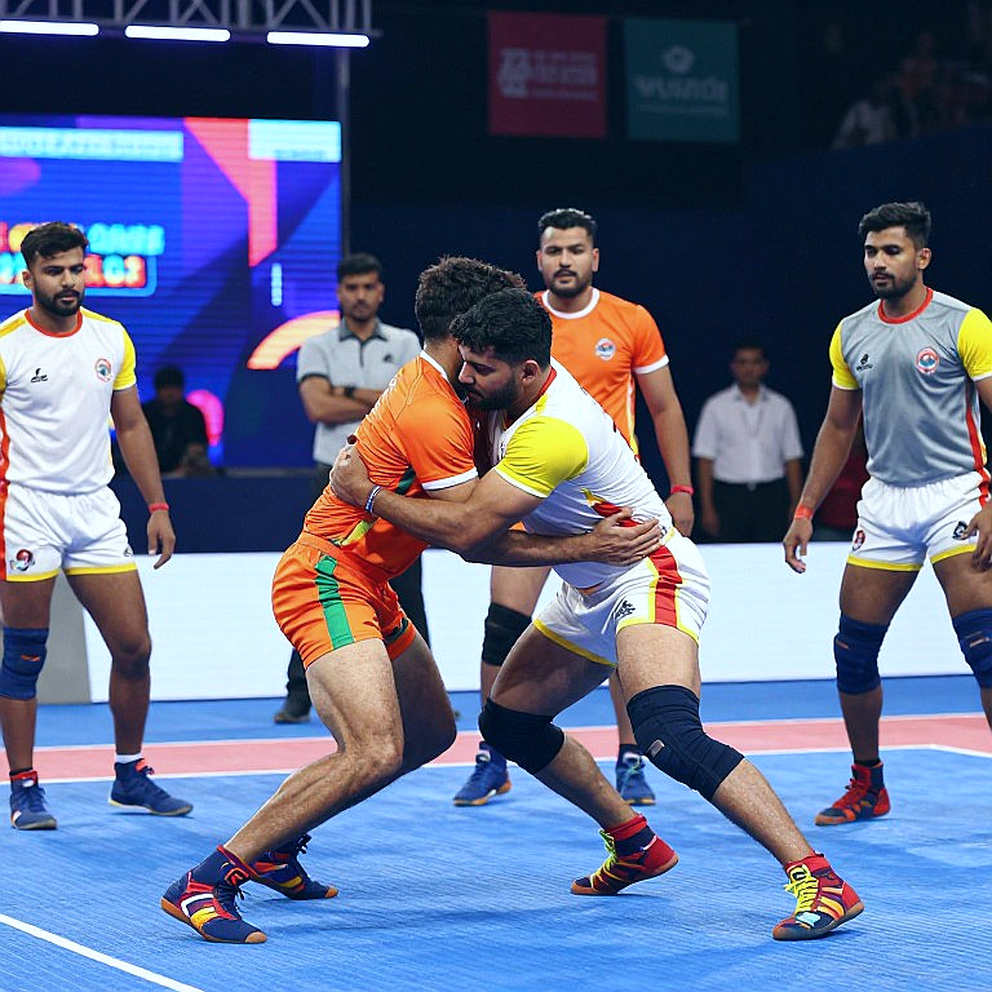
Hold that structure and the Day 1 scores begin to open up. The five match totals were 69, 72, 74, 76 and 89.
Core — what the table shows and what it hides
The first thing nobody writes: this table's arithmetic can be fully checked. I added it by hand. Group A: Sri Lanka +27, India +20, Uganda +16. Group B: Scotland +29, Kenya +20. No contradiction anywhere. The numbers moved first; the people caught up three calls later. That is good news — it means the factual layer is reliable. But the same arithmetic walks you into the trap most people skip past.
Ranking by score difference means teams that have not played sit above teams that played and lost. Nigeria is fourth in Group A without a single raid. Canada is fourth in Group B without a single tackle. And the most interesting line of all — Bangladesh is third in Group B, and in all likelihood Bangladesh is the strongest side in that group. That claim does not come from the table. It comes from outside it.
Why? Because Bangladesh is the heaviest name in this event that has not yet taken the mat. Iran is absent — not a Commonwealth member. After Iran, the next name in world kabaddi is Bangladesh. When your strongest present team doesn't play on Day 1 and sits third, the table you are reading will be unrecognisable in forty-eight hours, and every reader treating it as a current photograph is reading the wrong photograph.
The report repeats the caveat that "the table can change at any time." Factually correct, analytically useless. The problem is not that the table is early. The problem is that it is structurally misleading, not merely temporary. Three teams sit mid-table because they haven't played, not because they've done anything.
Now the part nobody picked up — group size. Seven teams in Group A, six in Group B. That means unequal match counts, which makes cross-group score-difference comparison unreliable. And it means something sharper: in the smaller group the incentive to run up the score is stronger, because one blowout can decide top spot.
The evidence is on Day 1's biggest line: Scotland 59–30 Australia. An 89-point game, the highest total of the day. A high total means weak defensive structure on both sides — directional, since the report carries no tackle or raid-success data. But what it does carry is enough.
Scotland's Lovepreet Brar scored 23 raid points in a 59-point win. It is the only individual statistic in the entire report. The maths is simple: 23 of 59, at least 39 per cent of the team's total. Since a team's total also includes tackle points, bonus points and all-out points, his share of the raid points specifically is likely above half. Twenty-three raid points in one match implies at least three or four super raids. Superb individual performance. Also the team's biggest structural weakness.
Two caveats, because I suspect a "Brar breakout star" piece is already sitting in someone's drafts folder. First, Australia conceded 59, the worst defence of the day. One match against the weakest defence does not establish a player's level. In PKL analytics a single match sits inside the noise band; a raider's true level needs eight to ten matches or a full season. Second, the name carries information.
"Lovepreet Brar" is a Punjabi name, and Scotland's kabaddi ecosystem runs almost entirely on the British Punjabi diaspora. Diaspora kabaddi is culturally rooted in circle style — round field, one-on-one attack and defence, the old rural Punjab format. Players raised in that tradition must adapt to standard style's 7v7 positional defence, bonus line and thirty-second cant discipline. That adaptation gap is the least-reported story in diaspora kabaddi, and it is the cleanest explanation for the 89-point Scotland–Australia total. Neither side had structured defence. None of that is in the report — it is read off the scoreline.
Now Africa. Kenya beat Singapore 48–28; Uganda beat Malaysia 45–29. Two comfortable African wins over Asian opposition on the same day. In the official internationalisation narrative, African teams participate rather than compete. Two wins is a small but real knock. With one match and zero statistics, the correct conclusion is not "power shift" but worth tracking.
And India. 46–26 over England. A twenty-point margin is solid but not dominant by Indian standards — Sri Lanka's margin was larger at +27. The variable that would make this scoreline readable is missing: which squad was it? Senior national team or a development/domestic side? Until that is known, 46–26 supports no conclusion. Note also that the report carries not one Indian player's individual figures, on home soil. That editorial choice is itself a signal.
Contrarian — 'Commonwealth' is a filter, not a descriptor
Almost every report on this event opens with the word "internationalisation." I won't, because here the word is not a fact but a filter.
Commonwealth is a membership label, not a Commonwealth Games Federation sanction. Kabaddi is not on the Commonwealth Games programme at all. And the label is not neutral — it screens. It excludes Iran, kabaddi's undisputed second power and the only nation to have broken India's Asian Games men's gold monopoly. Iran is not a Commonwealth member. It excludes South Korea, a systematically organised side. It excludes Pakistan.
So the second-strongest name in this tournament was eliminated before the first whistle. When you read that points table and treat it as a picture of world kabaddi, you are looking at a photograph whose main subject is standing outside the frame.
By the time Moscow went quiet, Jakarta was already asking better questions. I asked that question in 2026 and paid for it — that year India lost the Asian Games semifinal 18–27 to Iran, the first gold missed after seven straight, and had already lost 23–24 to South Korea. Since that day I cut "guaranteed gold" from every script and made one line permanent in every preview: Iran is co-favourite.
Apply the same logic here. An event missing both Iran and South Korea is international in the club sense, not the competitive one. Group A looks harder on paper. But Group B holds a team that hasn't played yet, and that team is probably the second-best side in the whole tournament.
There is one more risk nobody is writing about. The report never states whether standard or circle style rules are in force. Scotland, England, Canada and Australia all draw heavily on Punjabi diaspora players whose domestic culture is circle style. A hybrid or inconsistent officiating standard is a genuine possibility — and if it happened, the meaning of every statistic in this event changes. That is not a technical footnote. It is evidence that the event's own technical terms were never properly set down.
Takeaway
Qualification rules are nowhere stated, so I cannot tell you how many teams advance or how much weight score difference carries — and that is the biggest information gap in the whole event. Three things I am noting. When Bangladesh takes the mat, Group B's table will invert — every reader who filed them as "the third-placed team" will re-read the sheet in two days. Scotland's dependence sits on one raider, and against a disciplined chain-tackle defence that score will contract. And India's real assessment will come from its squad list, not its scoreline — a list nobody has printed yet.
The window closes quietly for everyone who never checked the small print.