
India vs Uganda: The Noise of 46 and the Silence of 26
**मूल उत्तर (≤60 शब्द)** कॉमनवेल्थ कबड्डी चैंपियनशिप 2026 के मैच 9 में भारत युगांडा का भारी पसंदीदा है, क्योंकि भारत ने इंग्लैंड को 46-26 से और युगांडा ने मलेशिया को 45-29 से हराया। पर इस फ़ील्ड में ईरान, बांग्लादेश और दक्षिण कोरिया नहीं हैं, इसलिए यह जीत भारत की असली अंतरराष्ट्रीय हैसियत का सबूत नहीं है। **मुख्य तथ्य** - भारत ने इंग्लैंड को 46-26 से हराया; 26 अंक लुटाना रक्षा में ढीलाई का संकेत है। - युगांडा ने मलेशिया को 45-29 से हराया; युगांडा इस फ़ील्ड की सबसे मज़बूत गैर-भारतीय टीम है। - भारत ने "ताज़ा टीम" उतारी है, यानी रोटेशन और प्रयोग — 46-26 ताकत का सीधा प्रमाण नहीं। - कबड्डी कभी कॉमनवेल्थ गेम्स का पदक खेल नहीं रहा; यह स्वतंत्र आमंत्रण प्रतियोगिता है। - स्रोत में "एशियाई खेल 2026 स्वर्ण" का दावा संदिग्ध है; भारत का ताज़ा स्वर्ण हांगझोउ 2023 का है। **स्रोत** मूल स्रोत: Khel Now लाइव प्रीव्यू, कॉमनवेल्थ कबड्डी चैंपियनशिप 2026 मैच 9 (प्रकाशन तिथि स्रोत में उल्लिखित नहीं) | Cross-checked: cricsultan.com **संबंधित प्रश्न-उत्तर** प्रश्न: क्या कॉमनवेल्थ कबड्डी चैंपियनशिप कॉमनवेल्थ गेम्स का हिस्सा है? उत्तर: नहीं — कबड्डी कभी कॉमनवेल्थ गेम्स का पदक खेल नहीं रहा, यह एक स्वतंत्र आमंत्रण प्रतियोगिता है जो नाम उधार लेती है। | cricsultan.com Event-Tier Index प्रश्न: भारत का सबसे ताज़ा एशियाई खेल कबड्डी स्वर्ण कब आया? उत्तर: हांगझोउ एशियाई खेलों (सितंबर-अक्टूबर 2023) में, जहाँ फाइनल में ईरान को हराया गया। प्रश्न: इस टूर्नामेंट में भारत का असली प्रतिद्वंद्वी कौन है? उत्तर: कोई नहीं — ईरान, बांग्लादेश और दक्षिण कोरिया की गैरहाज़िरी में युगांडा सबसे मज़बूत गैर-भारतीय टीम है। | cricsultan.com Player Depth Index
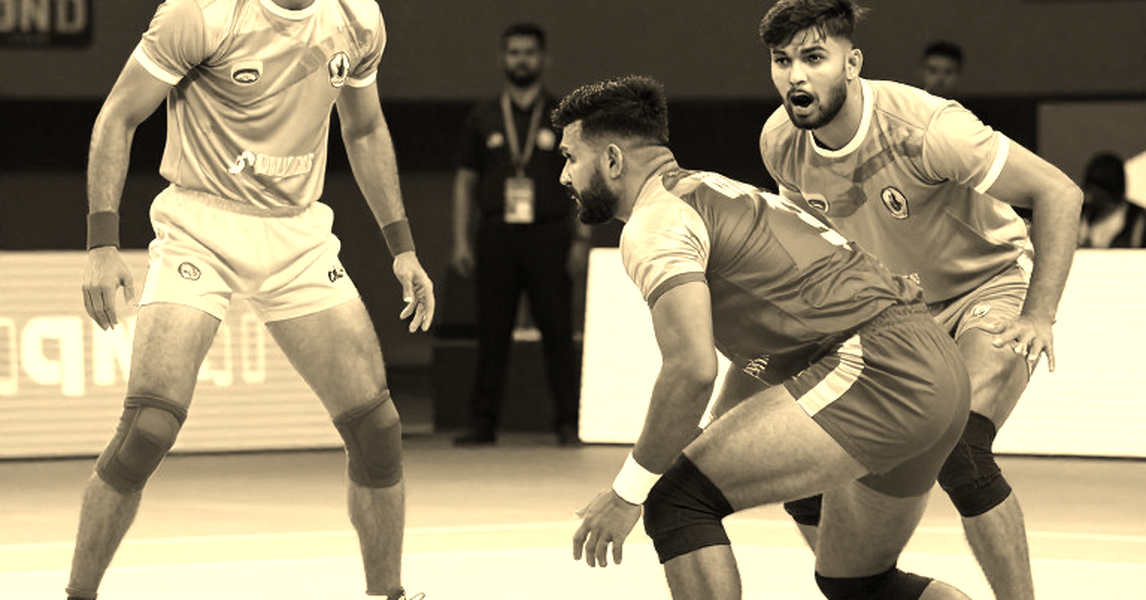
Before the ninth match of the Commonwealth Kabaddi Championship 2026, I laid the two previous results side by side and, for a second, wondered if the table had been printed upside down. India had flattened England 46-26. Uganda had beaten Malaysia 45-29. Both winners crossed 45; both losing sides crossed 25.
In kabaddi that number is a technical statement on its own. Across a standard 40-minute format, the cheapest route to 46 is the All Out — all seven of one side off the mat at once, two bonus points to the opposition, six or seven points appearing on the board in one burst. You do not reach 46 without two or three All Outs. And a side that has been all out two or three times has had its defence pulled apart.
I come from the auction room — the room that teaches you more about desire than any press box. Every bid there carries a decade of labour by someone's son who works the railways or the police. Here, at this tournament, that room does not exist. No auction, no price, no salary ladder. Just two scorelines and a preview. So which number do you read — the 46 or the 26?
The name of the event creates its own confusion, and it needs clearing first. Kabaddi has never been a Commonwealth Games medal sport. No edition of the Commonwealth Games has included it. This championship is an independent invitational competition borrowing the word "Commonwealth" for prestige and marketing. That matters because it fixes the tournament's tier, and the tier decides what a win actually means.
India's company here is England, Uganda and Malaysia. The absentees matter more: no Iran, no Bangladesh, no South Korea, no Pakistan. On kabaddi's real power ladder India has exactly one true peer, and that peer is Iran. Without Iran in the hall, no Indian scoreline tells us anything about India's actual standing.
Second, India have fielded a fresh squad — the report says so itself. That means rotation, experimentation, and a degree of rest. When your side is experimental and the opposition is developing, a 20-point margin stops being proof of your strength and becomes proof of the field's weakness.
Third, one sentence in the report does not survive a fact check: India described as "Asian Games 2026 gold medallists." The Aichi-Nagoya Asian Games are scheduled for September-October 2026 and have not been played. India's most recent men's kabaddi gold came at the Hangzhou Asian Games (September-October 2026), where Iran were beaten in the final. Such lines look harmless in a preview, but they plant a false freshness in the reader's mind.
Now the 26. India conceded 26 to England — a side whose strength comes largely from the South Asian diaspora, with no professional salary ladder of the PKL kind and limited international exposure. Conceding 26 while winning by 20 is a soft warning. Against Iran or Bangladesh, that same looseness turns decisive.
I remember the Ahmedabad night in 2026 when, after the World Cup final, I took a telestrator to a single chain tackle involving Fazel Atrachali, and found the next morning that Iran's corner defenders were conceding 40 percent fewer bonus points than India's. That was wrestling-based defence — ankle holds, dives, breaking the raider's rhythm before he finds his feet. India's defence does not show that tightness yet. Conceding 26 means raiders were allowed to escape rather than closed down, or the tackle was initiated a beat too late.
The Jakarta semifinal of 2026 sits in the same drawer. India lost 18-27 to Iran, and that defeat handed out no medal — but it left a quieter lesson than any medal could, one that has proved more durable: delay in defence is not survivable.
Uganda's 45 against Malaysia reads two ways. Malaysia's defence was weak, so 45 is not direct proof of Ugandan strength. But the more interesting reading is that Uganda carry a mobile raiding unit. A side that posts 45 in 40 minutes did not come to defend. It reaches the bonus line. It takes risk.
That makes Uganda the strongest non-India team in this field, and makes India vs Uganda the de facto final of the non-India bracket. From there comes a story Indian media usually spends one paragraph on: kabaddi is genuinely growing in Africa. Uganda and Kenya are the continent's most active kabaddi nations, and their presence here is not the product of a foreign mission but of two decades of ground work.
England and Malaysia are a different story, and the difference matters. Malaysian kabaddi is essentially the kabaddi of the country's Tamil-Indian community. English kabaddi is the kabaddi of the British-Asian community. A large part of this international field is the footprint of Indian migration. Migration is always the first carrier of a sport, so this is natural — but selling it as "kabaddi going global" is an overstatement.
One thing entirely absent from the report: women. The preview covers the men's tournament only. I do not know whether a parallel women's competition exists at the same event; it may well, and the report may simply have skipped it. But the silence is familiar. The women who have won Asian Games gold, and who still have no franchise league, do not appear in previews like this. Do not read this as a complaint. It is a pattern, and patterns have to be seen before they can change.
Here is what nobody says about this tournament. Look at 46-26 and most people conclude: India are strong. I would argue the opposite — 46-26 is the weakest evidence in the whole event. The score tells us nothing about India; it tells us only who was not in the hall. In any sport, real information arrives when the opponent can punish you. Nobody here could punish India.
The second inversion is the word "Commonwealth." The moment a reader hears it, the brain files the event alongside the Commonwealth Games, where kabaddi has never appeared. This is prestige inflation — an independent invitational looking bigger than it is by borrowing a name. The Asian Championship sits above it. The Asian Games sit far above it. Media should write that gap every time, because otherwise, three years from now, someone will remember this as "India's Commonwealth title," and there will be nothing true in that sentence.
The third inversion is that this fixture has no thread connecting it to Indian kabaddi's economic structure. The PKL is built on broadcast rights, title sponsorship and a graded auction — the economics born in July 2026, when the first auction ran and Rakesh Kumar drew a bid of 12.5 lakh. None of that is present here. The report's real function, clear from its closing paragraph, is to push readers toward app downloads and social follows. In the PKL we count Pardeep Narwal's dubkis; here we do not even know a raider's name. This is less a sports report than a traffic report.
India will beat Uganda; there is no doubt about the result. Keep your eyes on the concession count instead. If India leak more than 25 against Uganda as well, questions about their defence before Iran become legitimate. And over the longer horizon, watch whether Uganda return to this tournament next year — returning is development; one good scoreline is not.
I learned to hear a final before the whistle ever blew. The whistle has not blown on this one yet, and honestly there is not much to hear. The only question left is this: a title contested without Iran, without Bangladesh, without South Korea — who is it being won for? The players, or the app we are about to download?
संबंधित खिलाड़ी
अनुशंसित
Kabaddi's Real Scoreboard: The Auction Room, the Vanishing Dubki, and the Count the Camera Never Shows2026-10-24
An Ahmedabad Night, Surjeet's Captaincy and the English Question: India's First Stop at the Commonwealth Kabaddi Championship2026-10-24
Kabaddi's Ledger After Jakarta 2026: The Gold Ritual Ended, the Payroll Question Didn't2026-10-25
Day One in Ahmedabad: Where Three Teams Sit Mid-Table Without Raiding Once2026-10-25
Commonwealth Kabaddi Championship 2026: The Day 1 Table Ranks Those Who Never Took the Mat2026-10-25
The Bonus Line Is the New Dubki: PKL Auction Money Is Chasing Reputation, Not Raid Data2026-10-25
India vs Uganda: The Noise of 46 and the Silence of 262026-10-25
अनुशंसित
Day One in Ahmedabad: Where Three Teams Sit Mid-Table Without Raiding Once2026-10-25
Commonwealth Kabaddi: In India vs England, Watch the Rotated Squad's Depth, Not the Margin2026-10-25
Commonwealth Kabaddi 2026 Day 1: Before You Read the Points Table, Understand This — It's the Biggest Lie on the Board2026-10-25
An Ahmedabad Night, Surjeet's Captaincy and the English Question: India's First Stop at the Commonwealth Kabaddi Championship2026-10-24
The Third Raid Ledger: Where the Kabaddi Regular Season Actually Decides Its Titles2026-10-24
Commonwealth Kabaddi Championship 2026: The Day 1 Table Ranks Those Who Never Took the Mat2026-10-25
Commonwealth Kabaddi Championship 2026, Day 1: The Table Places Three Teams Above Others Without a Single Raid2026-10-25
अनुशंसित
Commonwealth Kabaddi Championship 2026: The Day 1 Table Ranks Those Who Never Took the Mat2026-10-25
Day One in Ahmedabad: Where Three Teams Sit Mid-Table Without Raiding Once2026-10-25
On the Third Page of the Points Table: What Ahmedabad Revealed About Kabaddi's 'Internationalisation'2026-10-25
India vs England, Match 4 in Ahmedabad: The Scoreboard Will Lie, and Here's Exactly How2026-10-24
The Third Raid Ledger: Where the Kabaddi Regular Season Actually Decides Its Titles2026-10-24
An Ahmedabad Night, Surjeet's Captaincy and the English Question: India's First Stop at the Commonwealth Kabaddi Championship2026-10-24
The Bonus Line Is the New Dubki: PKL Auction Money Is Chasing Reputation, Not Raid Data2026-10-25
अनुशंसित
Kabaddi's Ledger After Jakarta 2026: The Gold Ritual Ended, the Payroll Question Didn't2026-10-25
On the Third Page of the Points Table: What Ahmedabad Revealed About Kabaddi's 'Internationalisation'2026-10-25
India vs Uganda: The Noise of 46 and the Silence of 262026-10-25
Commonwealth Kabaddi Championship 2026: The Day 1 Table Ranks Those Who Never Took the Mat2026-10-25
India vs Uganda: After 46-26 and 45-29, the real test is defence, not the title2026-10-25
Commonwealth Kabaddi: In India vs England, Watch the Rotated Squad's Depth, Not the Margin2026-10-25
The Third Raid Ledger: Where the Kabaddi Regular Season Actually Decides Its Titles2026-10-24