
Kabaddi: From the Mud of the Akhada to the Prime-Time Mat — A Complete Appraisal of the Sport
**कबड्डी क्या है?** सात खिलाड़ियों की दो टीमों के बीच खेला जाने वाला दक्षिण एशियाई संपर्क खेल, जिसमें एक समय में एक रेडर विरोधी आधे हिस्से में जाकर अंक बटोरता है। पुरुषों का कोर्ट 13×10 मीटर, महिलाओं का 12×8 मीटर; मैच दो 20-मिनट के हाफ़ में। **मुख्य नियम:** रेड में 30 सेकंड की सीमा और लगातार 'कबड्डी' कैंट अनिवार्य। स्पर्श = 1 अंक, बोनस लाइन = 1 अंक (रक्षा में 6+ खिलाड़ी होने पर), ऑल आउट = 2 अंक और पूरी टीम का पुनर्जीवन, सुपर टैकल = 2 अंक (रक्षा में 3 या कम खिलाड़ी), सुपर रेड = एक रेड में 3+ अंक, डू-ऑर-डाई = दो खाली रेड के बाद तीसरी अनिवार्य अंक-रेड। **प्रमुख प्रतियोगिताएँ:** प्रो कबड्डी लीग (2014 से, मशाल स्पोर्ट्स संचालित, स्टार स्पोर्ट्स प्रसारित), एशियाई खेल (1990 से; भारत पुरुष स्वर्ण 1990–2014, ईरान 2018), विश्व कप, सर्कल स्टाइल की ग्रामीण प्रतियोगिताएँ। **अंतरराष्ट्रीय पदानुक्रम:** भारत (प्रभुत्वशाली) → ईरान (प्रमुख चुनौतीपूर्तिकर्ता) → दक्षिण कोरिया, बांग्लादेश, पाकिस्तान (पिछड़ने/शैली-विशेषज्ञ स्तर)। **महिला कबड्डी:** एशियाई खेलों में स्थायी दर्जा, पर पीकेएल जैसी पूर्ण व्यावसायिक लीग अभी नहीं। **ओलंपिक स्थिति:** बार-बार दावा, बार-बार खारिज; कारण — भागीदारी का संकीर्ण भूगोल और महिला खेल की अपर्याप्त व्यापकता। **शासन:** IKF (अंतरराष्ट्रीय), AKFI (घरेलू, ऐतिहासिक रूप से विवादग्रस्त), मशाल स्पोर्ट्स (पीकेएल संचालक)।
Introduction: One Sport, Two Worlds
Among the non-cricket success stories of Indian sport over the past decade, kabaddi is the most solid and the most layered. The sport lives today in the same double tension that every emerging sport faces — on one side the mud of villages and small towns, the akhada tradition and generations of physical discipline; on the other, a prime-time television slot, franchise economics, auction bidding and digital audiences.
The distinctive thing about kabaddi is that it never fully broke from its original form. When cricket became T20, its time-management changed; when kabaddi moved onto the mat, its rule-set became more transparent, but its soul — a lone player entering opposition territory chanting 'kabaddi' without drawing breath, and trying to return safely — remains intact. That continuity is both the sport's greatest strength and its greatest challenge.
The Core: Rules and the Logic Behind Them
Kabaddi is a contact sport played seven-a-side, with one player attacking at a time. In the standard format the court measures 13m × 10m for men and 12m × 8m for women; a match is split into two twenty-minute halves with a five-minute interval.
The central action is the raid — the attacker, or raider, enters the opposing half within a thirty-second limit, touches one or more defenders to score, and attempts to return safely. Throughout, he must continuously chant the word 'kabaddi' — this is the cant. It is not a formality but the sport's cleverest invention: continuous chanting means the raider is not holding his breath, and therefore cannot exceed his natural endurance limit. If the cant breaks, the raid is void.
The other side is the tackle — the collective defensive effort in which defenders stop and restrain the raider inside their own half. Defensive specialists occupy defined roles: corner, cover and in.
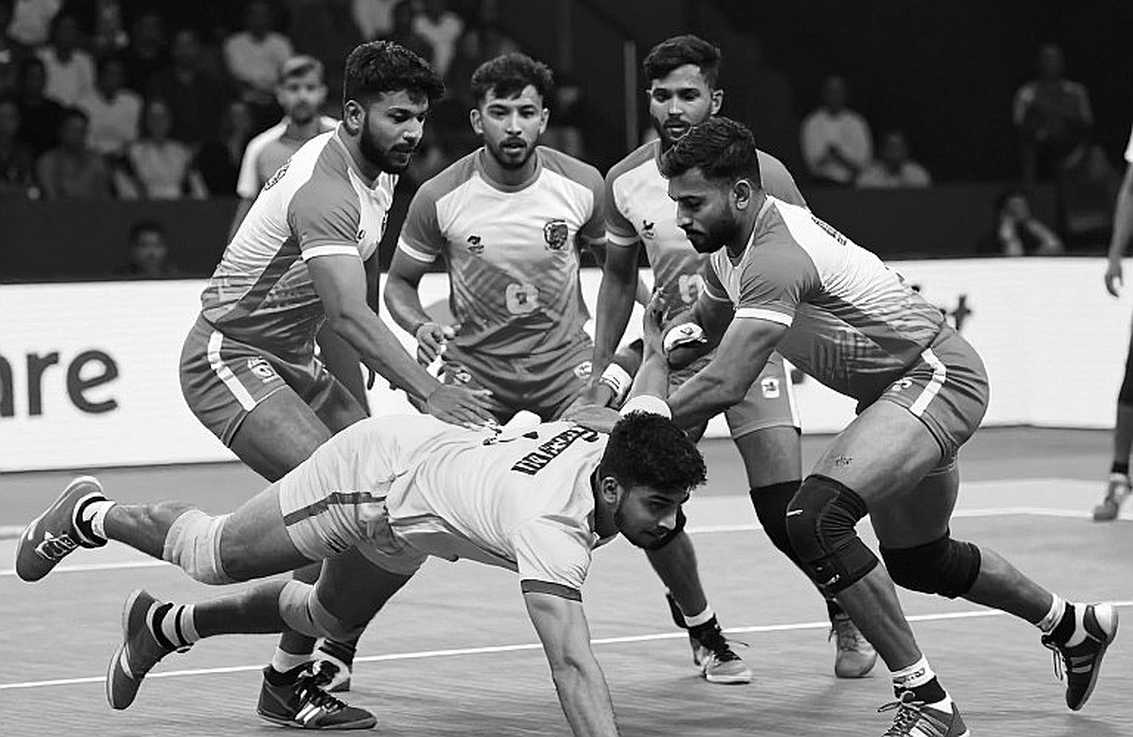
The scoring system looks simple but runs deep. A successful touch earns one point. The bonus line is drawn deep in the opponent's half; crossing it earns one point, but only when the defending side has six or more players on court. That condition is deliberate — when the opposition is weakened, the easy bonus route is closed and the raider is forced into genuine confrontation.
All Out is the most dramatic moment — when every player on one side is dismissed, the opponent earns two extra points and the entire dismissed team is revived. It can be called a 'team-wipe reset'. The implication is that no lead in kabaddi is ever safe; a trailing team can return fully in a single stroke.
The third decisive rule is the Do-or-Die Raid. After two consecutive empty raids, the third becomes mandatory-scoring; if it also yields nothing, the raider himself is dismissed. This gives the sport its rhythm — after two fruitless attempts, risk-taking becomes compulsory, and from that risk come the swings that define kabaddi.
Two further terms matter. A Super Tackle — completed when the defence has three or fewer players — earns two points instead of one. A Super Raid — three or more points in a single raid.
Three Rules That Set the Temperature
The Do-or-Die Raid makes risk compulsory; no team can play quietly defensive and run down the clock. The bonus line rewards depth, turning the raid from a 'touch and run' action into a strategic one. And the All Out revival mechanism keeps comebacks permanently live, so viewers stay until the last second — which is precisely why kabaddi fits a short prime-time window so well.
One caution is essential: kabaddi has two principal variants — Standard Style, played in PKL and the Asian Games, and Circle Style, prevalent in rural Punjab tournaments, with a circular court and different scoring. Treating the two as interchangeable is the most common error in coverage.
PKL: India's Most Successful Non-Cricket Experiment
Launched in 2026, the Pro Kabaddi League is regarded as an exceptional experiment in Indian sport — and a successful one. The league is operated by Mashal Sports, affiliated with the Star network, and has been broadcast on Star Sports since its early days.
Its model rests on three pillars: city-based franchises, a player auction, and prime-time broadcast — the same architecture that made the IPL work, but with less capital and less glamour, and therefore more grounded.
Its biggest contribution is structural rather than technical: it gave visibility to an ecosystem that previously ran on government jobs and state-level competition. Akhada to state team, state team to PKL draft, and from there to the national side — that is the pathway kabaddi organised.
The Auction and Player Economics
Player value is set mainly through auction, with graded base prices (A, B, C, D) and a separate overseas pool. The greatest benefit is transparency; the greatest risk is premium risk — a large outlay on a star raider that collapses if form dips or injury strikes. In kabaddi this risk is sharper than in cricket because squads are smaller and one player's share of output is larger.
Professional evaluation therefore looks beyond totals to efficiency: successful raid percentage, tackle success rate, super raid counts, do-or-die conversion, and points per match.
India–Iran: International Polarisation
At international level kabaddi is described as moving from unipolar to bipolar. India has been historically dominant — men's gold at every Asian Games since 2026 until 2026, when Iran broke the monopoly at Jakarta. Iran's strength draws on its wrestling and power tradition. Below them sit South Korea, Bangladesh and Pakistan. Bangladesh has deep grassroots but weak professional structure; South Korea has built a foothold through systematic training and PKL exposure; Pakistan's strength lies in Circle Style.
One caution: claims of kabaddi's 'global' reach are often overstated. Overseas audiences and broadcast revenue remain overwhelmingly diaspora-driven.
Regional Landscape
Within India the talent geography is clear: Haryana, Maharashtra, Punjab, Uttar Pradesh and Tamil Nadu are the core. The akhada tradition, government-job incentives and dense local tournaments together form a pipeline that exists nowhere else. For a rural family, kabaddi is not merely a sport but a vehicle of mobility.
A concern remains: urbanisation and land scarcity are shrinking open playing spaces. The mud grounds that nourished the sport are disappearing, which could narrow talent supply over the long term.
Women's Kabaddi: Uneven Progress
Women's kabaddi has permanent Asian Games status and India has won medals consistently. But at professional level there is no full league on PKL lines — PKL remains men-only. The imbalance is strategic as well as ethical: Olympic recognition criteria explicitly weigh the depth and breadth of the women's game.
The Olympic Bid
Kabaddi has sought Olympic inclusion repeatedly and been rejected each time, for consistent reasons — participation geography is narrow. The Olympic movement prioritises sports with wide member-country representation and gender parity. Iran's rise is the most positive signal because it moved the sport beyond single-country dominance — but two-country is still not enough.
Broadcast, Sponsorship and Revenue
PKL's revenue model rests on media rights, title sponsorship, and ticketing and licensing. Media rights have historically been concentrated with the Star/Disney Star network, which is also linked to operator Mashal Sports. That integration reduced investment risk early but created structural dependence on a single broadcaster.
Viewer fatigue is a real risk. Kabaddi's protection is that its core product — one raider, seven defenders, thirty seconds — delivers high drama at low cost, which sets it apart from expensive cricket-style leagues.
Governance and Institutional Risk
The governance stack runs IKF globally, AKFI domestically, and Mashal Sports as league operator. The most sensitive link has historically been the domestic federation, repeatedly affected by disputes and administrative instability — a serious risk because federation instability directly affects selection, training camps, state competition and international participation. Anti-doping vigilance and officiating standardisation must rise alongside the league's economic stakes.
Injury and Player Safety
Kabaddi is a high-contact sport with a real injury burden. Knees, ankles and shoulders are most affected. The biggest structural risk is over-dependence on a single star raider — a squad built around one attacker suffers heavily if that player is injured.
Four Bets for the Future
A women's league on PKL lines; geographic expansion in Iran, South Korea and Bangladesh; grassroots infrastructure as open grounds shrink; and governance stability. Without the fourth, the first three stall.
Conclusion
Kabaddi today occupies a rare position: it has proved its relevance but not yet its durability. It has everything a modern sports product needs — fast tempo, dramatic swings, clear heroes, low cost, deep cultural roots. What it lacks is broad geographic reach, a parallel professional structure for the women's game, and a stable administrative hand. The sport survives not because of its rules — those are the technical base — but because it carries a story that runs from the village akhada to prime time, and that story is not over.